
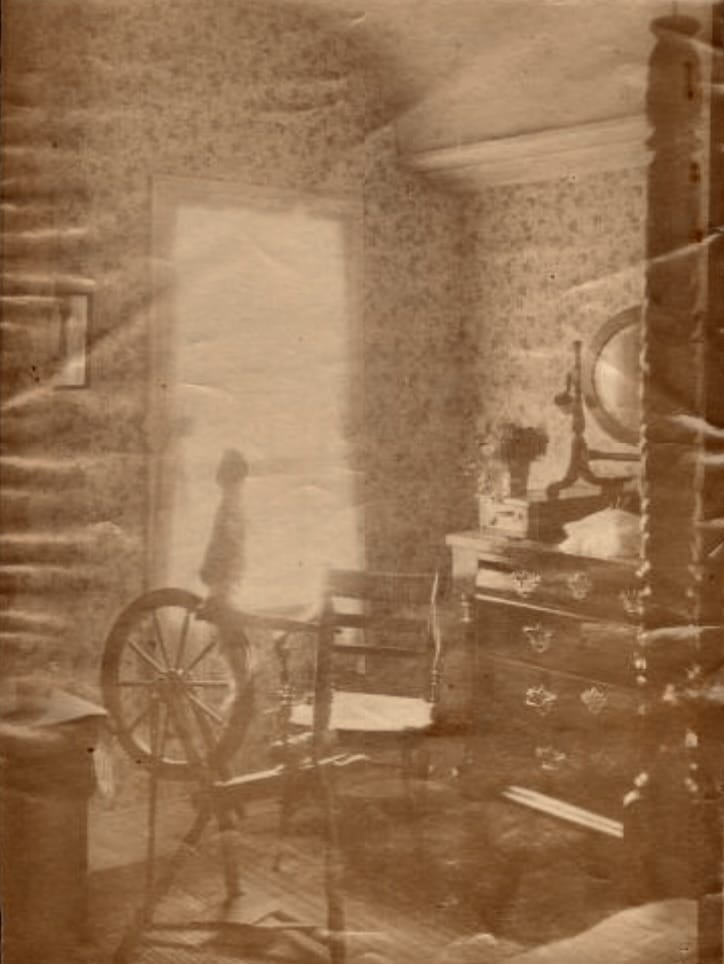
In 1820 when Sylvester family descendant Sylvester Dering died after a riding accident, his wife Esther Sarah Havens Dering took over the management of the Manor house and farm. Cash poor Esther Sarah employed the services of many formerly enslaved people of color living on Manor lands or on Shelter Island in a barter system of trade. Services such as washing laundry, chopping wood, house cleaning were exchanged for supplies such as pork, butter, cloth and rum. Several notations in her account book list payment to women for spinning flax.
For centuries the tradition of spinning flax was done by women to make yarn that was then woven into a linen cloth. The process transforms long, inelastic plant fibers into strong, smooth linen yarn, Making the yarn requires a distaff too to hold the mass of fibers and a specialized wheel – a spinning wheel to lay down fibers and spin them into a twist to produce a fine thread that can be woven into cloth. This homespun linen cloth would be used to make kitchen towels and aprons for instance.
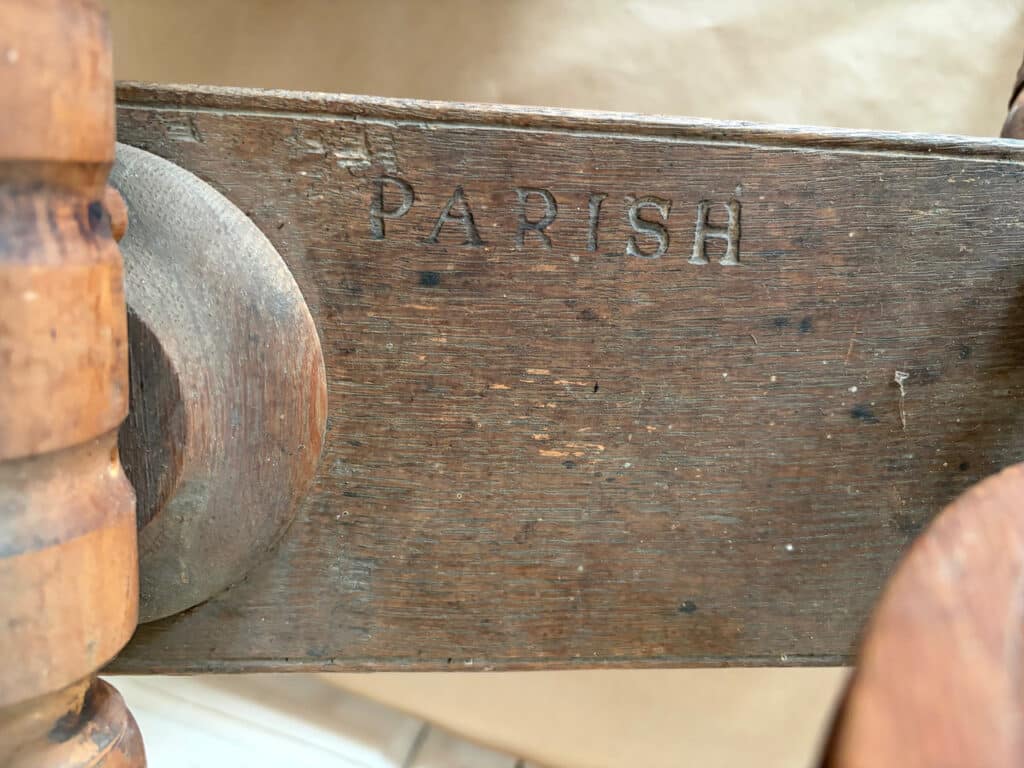
Within the Manor House as we continue to catalogue and research the various items, furniture and objects in anticipation of our upcoming restoration project, we have uncovered several spinning wheels of various sizes. One of the smaller wheels is believed to have been used to spin flax. A maker’s mark indicates this spinning wheel was crafted by either Isaac or Ambrose Parish between 1766-1836 or 1764-1847 respectively, in Oyster Bay, Long Island. These men were niche carpenters–joiners/turners–specializing in these kinds of devices, and they ran a shop selling their goods in the town of Oyster Bay.
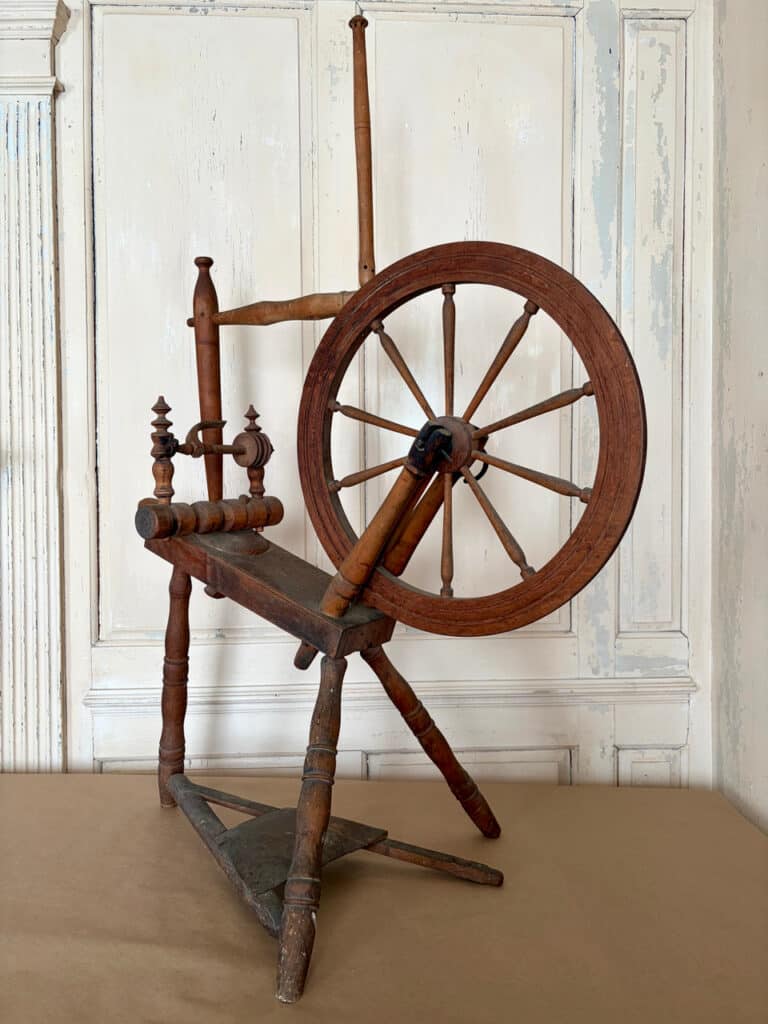
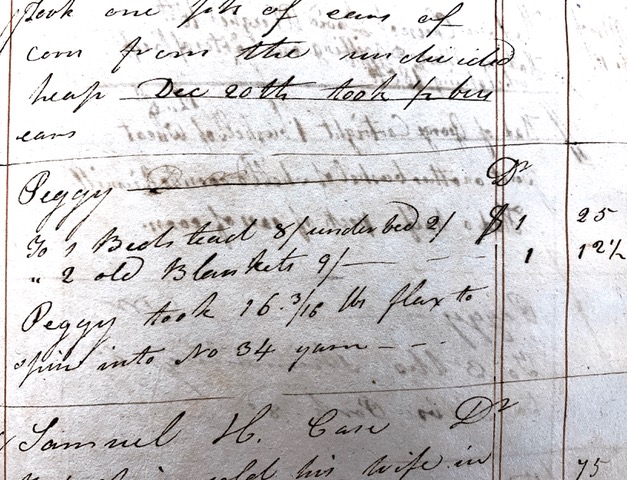
Finding the spinning wheel in the Manor house attic caused us to consider who might have used it so many years ago. Turning again to Esther Sarah’s account book, we came across a notation that states that a woman named Peggy took 16 lbs of flax to spin into #34 weight yarn. The note written ca. 1825 is a small glimpse of life at the Manor and the work done there. We know that the name Peggy refers to an African-American woman named Peggy Case.
Born into enslavement in Southold, she is first documented in a baptism record from the Mattituck Presbyterian Church. On October 9, 1768, she was baptized with the name Margrett, alongside her sister, Thankful. Both sisters, and their mother, Dorcas, were enslaved within the household of Issac Reeve. She was sold to David Wiggins of Mattituck and manumitted in 1806 at the age of 50. Along with her husband Jason Case and their two children, they moved to Shelter Island to join her extended family that included her mother and Aunts Matilda and Violet. They lived in a house owned by the town of Shelter Island and continued to work at Sylvester Manor and other properties on the island. Peggy or Aunt Peggy as she was known died in October of 1870, and local newspapers reported that she was the oldest person in Suffolk County to die that year.
Attributing the work done on the spinning to Peggy and other women of color gives the object extra significance for us. Peggy’s life and family legacy have been of major importance in our continuing research and we honor her in telling this story of spinning flax at Sylvester Manor.