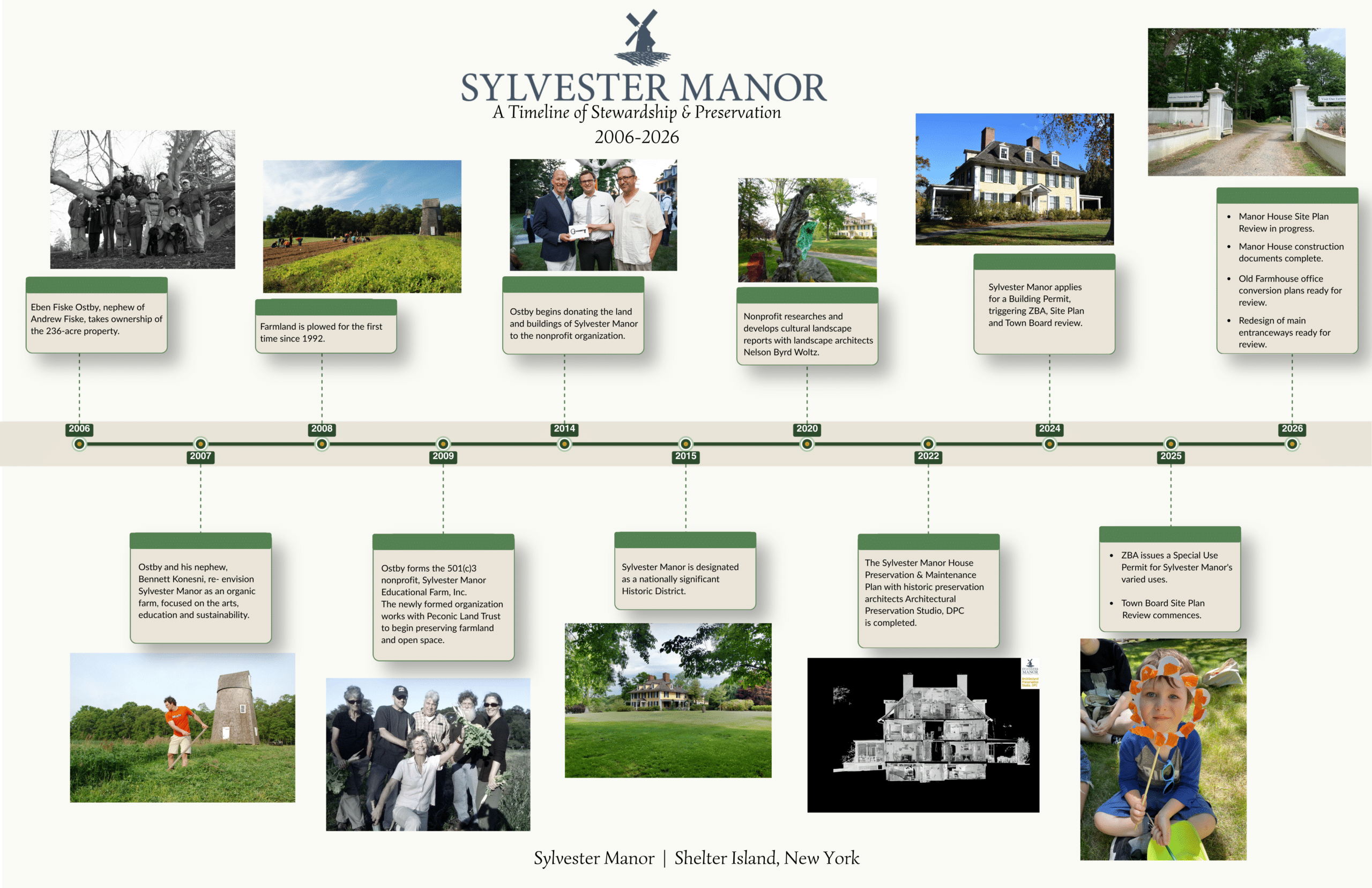
The preservation of Sylvester Manor—a 236-acre nationally significant historic district along a meandering shoreline in the heart of Shelter Island—stands as a powerful testament to the enduring value of public trust in an increasingly privatized world. The former estate passed down through 11 generations of its founding family before being gifted to the community as a nonprofit educational institution. It encompasses forests, fields, and wetlands, with a working farm, historic structures undergoing rehabilitation, and a now quiet waterfront that once connected this Island to the world.
Sylvester Manor offers East End residents and visitors alike a singular opportunity to experience a living cultural landscape that celebrates open space, explores our region’s layered history and connects us with stories, ecosystems and traditions that continue to shape our shared sense of place. We welcome your interest and input as we continue to transition the site from private estate to public resource open and accessible to all. Below are answers to some Frequently Asked Questions about capital projects now coming to fruition after many years of careful planning. If you have additional questions, please contact us at info@sylvestermanor.org.
The Manor House was last extensively renovated and expanded in 1908. Working with preservation experts and building on a decade of research, we developed plans to rehabilitate the entire house and adaptively reuse its “newer” additions as our Center for History & Heritage. Sylvester Manor is a nationally significant historic district added to the National Register of Historic Places in 2015 with the house as its primary contributing resource. As such, the work must meet the Secretary of the Interior’s Standards for Historic Preservation. Our plans call for complete exterior rehabilitation from the foundations to the roof, including cladding, windows, doors, and trim. Inside, all 46 rooms will benefit from updated electrical wiring, plumbing, HVAC, insulation, fire detection and suppression, and enhanced ADA access. Once refurbished, the oldest front portion of the house will continue to serve as a museum offering tours, exhibits and educational programming about this extraordinary place. Alterations in the newer additions will convert existing rooms into offices and support spaces for staff and visiting scholars/artists, who will occupy three en-suite bedrooms while engaged in work based on the extensive archives and special collections we hold in public trust.
The project has been undergoing site plan review since October 2025. The Town Board opened a public hearing in April 2026 to receive comments. It recently voted to reopen the public hearing on Monday, June 29, 2026 for additional information requested by P.W. Grosser, a consulting firm assisting with the SEQRA determination. Due to recusals, only three board members are taking part, meaning the vote to approve must be unanimous.
No. Most of our programs occur outdoors and are allowed under NYS Agricultural District provisions and ZBA special permit, so no impact is expected on planned activities for the summer and fall. See a full calendar of events at sylvestermanor.org.
Under Town Code, site plan review may consider up to 14 different elements, including traffic, parking, exterior lighting, etc. Due to the project’s complexity and ZBA-approved change in use from residential to educational, our review covers most elements, including some that typically would not arise for businesses operating in existing commercially-zoned properties. For example, another project under review by the state expands the primary entry at Route 114 from single lane residential apron to two-lane minor commercial apron. Because this is a state road, the NYS Department of Transportation is the primary reviewer. Although it’s part of a separate project (see details below), the Town Board asked to see the DOT-approved plan to satisfy traffic concerns, confirm proposed drainage, and calculate approximate ground disturbance. The Town Board has also focused on parking, ADA access, and environmental protections. See our extensive submissions on the Town website on the Pending Laws & Discussions tab.
Yes. We obtained the required ZBA special permit in October 2025, and have received signoff from the National Park Service Historic Preservation Office, the Environmental Protection Agency, the NYS Office of Parks, Recreation and Historic Preservation, the NYS Department of Environmental Conservation, and the Suffolk County Department of Health Services. Looking ahead, after site plan review concludes, we’ll work with the Building Inspector to finalize a Building Permit, a process that will likely take weeks or months to complete.
Once we have a Building Permit, we’ll seek proposals from prospective general contractors. It will take about three months to complete the bidding process. Once a general contractor is selected, we’ll be able to determine an appropriate start date for construction.
Construction will take an estimated 2.5 to 3 years.
To create a project budget, we obtained two estimates — from a builder with regional experience in this type and scale of work and from a professional construction estimating firm. We expect the project will cost at least $13M to complete. As of June 9, 2026, we’ve raised over $8.5M from public and private grantors, foundations and individual donors. Some of the grant funding is in the form of reimbursement, meaning we will be paid back for allowable costs under strict accounting procedures as the work progresses rather than receiving money in advance. If you would like to learn more about our fundraising efforts or make a contribution please contact Alyse Clark at amclark@sylvestermanor.org.
The plan builds on years of careful study by preservation experts. The 1737 Manor House is the primary contributing structure to the site’s 2015 designation as a nationally-significant historic district on the National Register of Historic Places. After the family formed the nonprofit in 2009, it gifted individual tax lots to the organization, a process that took several years and, for some parcels, involved multi-party sales of development rights, which protected the subject land in perpetuity while funding reserves needed for organizational stability. At first, apprentice farmers occupied the Manor House seasonally, and staff had offices there. In 2014, when the nonprofit obtained title to the primary 138-acre tax lot, we commissioned a historic structure report on the Manor House, a first step toward obtaining further grant funding for historic preservation. That enabled a deeper dive in 2016 with a formal existing conditions assessment. During the pandemic, we took a broader look at the site’s other facilities and assessed the cultural landscape across the entire 236 acres. We also found alternate housing for our apprentice farmers, reducing pressure on the Manor House. In 2022 with grant funding, Architectural Preservation Studios, DPC, completed a technical preservation and maintenance plan that aided in identifying appropriate future uses for the Manor House. In 2023 with grant funding, the firm began work on the current plan, which we submitted to the Building Department in February 2024 to start the local permit process which is still ongoing.
A digital inventory of the Manor House collections has been underway since April 2024, building on paper-based records gathered over many years. We have cataloged, packed and moved to temporary, secure storage most smaller items, including several thousand household and personal objects and books. We’ve also cataloged larger items requiring specialized handling, such as furniture, which will be placed in conditioned secure storage before construction begins. We’ve partnered with the Shelter Island History Museum to store our most prized archival materials and historical artifacts in their state-of-the-art vault for the project’s duration. The Manor House will be empty of its contents before construction starts.
We propose primary entry improvements at Route 114 and Manwaring Road and updates to a secondary Route 114 entry at the Quaker Corner (home to our Quaker meeting and monument, family burial ground, and a private residence). At the primary entry, we plan to remove the existing concrete planters and stone gateposts; widen the apron to allow two vehicles to pass, and; add a separate pedestrian grass walkway to enhance safety, as well as an interior driveway crosswalk connection to a bike rack at the head of our trail network. The revised entry will include decorative gateposts (no actual gates) and fences, with new plantings, signage and lighting. At the Quaker Corner, we propose restoring the existing structural elements, while clearing trees at the end of their lifecycle and making minor improvements to grading, drainage, landscaping, lighting, and signage. Noted American landscape architect James L. Greenleaf designed both entries featuring similar elements. By making minor updates to the Quaker Corner entry, we continue to represent his circa 1915 contribution within the built environment. Nelson Byrd Woltz Landscape Architects designed the modifications and new primary entry, which references a much earlier configuration and results in a more open and inviting public threshold at this important intersection in Shelter Island’s town center.
Due to the proximity of state-controlled wetlands at Gardiners Creek, this project is under review by the New York State Department of Environmental Conservation. The proposal has been conditionally approved by the NYS Department of Transportation, which regulates work along state highways. Under DOT conditional approval, we are required to hire a contractor familiar with state roadworks, and together provide certain pro forma materials, such as proof of insurance coverage.
After the NYS DEC completes its review, we will apply to the Building Department for required demolition and construction permits. At the discretion of the Building Inspector, we will undergo necessary town reviews, including possible wetlands permitting. As the Quaker Corner work area falls within a 16-acre town preservation easement, the Town Board may require additional review. Given the change in use from private residential to educational, the Town Board may call for site plan review of both entries.
Work on the Route 114 Entries project cannot start until the regulatory review process is complete. Once the necessary permits are obtained we will select a contractor who will help us determine the construction schedule. We will announce details as they become available.
We obtained an initial estimate of about $370K from a contractor familiar with this type of project; we are seeking funding for the construction work. The design/engineering phase was covered by a $250K New York State CREST grant; then-Assemblyman Fred H. Thiele was our legislative grant sponsor.
In 2025, Suffolk County purchased the development rights to the two parcels of land we own just east of Second Bridge, straddling Winthrop Road. They are remnants of the manor’s Dering Harbor historic shore, dating to when the Sylvester family first came into possession of the entire island. Eleven generations later, these parcels were included in their descendant’s establishment of the nonprofit in 2009, and transfer of title in 2014. We retained the option to sell, if needed, to support organizational stability. Waterfront and waterview properties are in high demand, and a developer could have subdivided the upland parcel into two luxury homesites. Instead, we partnered with Suffolk County to extinguish the development rights. Together, we’ve preserved its character and ensured perpetual public access for passive recreation at Dering Harbor—the only shore-level public access to this iconic Shelter Island waterway. Maintaining this connection serves an important historic preservation goal. It allows the public to experience the relationship to the sea that shaped lifeways of the island’s earliest inhabitants, the colonists who followed, and the maritime industries, agriculture and aquaculture practices, and recreational traditions that have remained central to our region’s story ever since. The county easement terms require us to provide parking for at least five vehicles within the upland parcel.
Working with Nelson Byrd Woltz Landscape Architects and reinforcing a landscape vocabulary they helped us establish for our Route 114 entries, we arrived at a design for a gravel driveway and small parking area positioned in the safest location. Newly introduced elements in the built environment will be embedded within a pollinator meadow and screened by a grove of trees and native plantings aligned to maintain views across adjacent preserved farmland. The plan includes a generous 18-foot buffer between our new driveway and our immediate neighbor’s driveway, which abuts our shared property line. Details to be determined are our neighbor’s preference for plantings and/or fencing along this boundary. Also included are a suggested crosswalk to enhance pedestrian safety, a bike rack, and an information kiosk at the connection to our public trails. Along the waterfront, we propose only minimal interventions, including regulatory signage outlining the terms of public access. While paddlecraft are welcome, motorized vessels may neither land nor be launched from this location, which will be open from dawn to dusk. We aim to create welcoming space for residents and their guests to safely enjoy this very special remnant of our Historic Shore.
This project is under review by the New York State Department of Environmental Conservation, which has preliminary regulatory authority over the wetlands. Under the easement terms, we are keeping our county partners informed of our progress.
Once we’ve satisfied the DEC, we can submit our plans to the Building Inspector, who will determine any additional local review that may be required. Proximity to the shore, the proposed crosswalk at Town-owned road and other elements may prompt additional oversight such as wetlands and site plan review.
This plan is in the earliest stages of regulatory review with no proposed start date at this time. Once the review process is complete we will select a contractor who will help us determine the construction schedule.
The work includes additional clearing of invasives, minimal regrading, installation of permeable gravel driveway and parking surfaces, drainage, and planting of native trees, shrubs, grasses and a pollinator meadow. Additionally, we will reroute connections to our grassy trails and install a bike rack, signage, and fencing. The construction schedule will be determined by a contractor and will likely take several months to complete.
We obtained an estimate of about $200K from a contractor familiar with this kind of work; we’ll fund this project with proceeds of the sale of development rights to Suffolk County.
Last year, we undertook a formal study of the Old Farmhouse thanks to a Preserve NY Grant (see details below), and determined that the centrally located structure, which we recently purchased to re-incorporate into the Manor, could be readily adapted for use as our offices. The three-bedroom, three-bathroom building is actually a combination of structures and is a contributing resource to our nationally significant historic district on the National Register of Historic Places. The main house was built circa 1850 and later two older structures were attached that likely were moved from locations within Sylvester Manor — one is a house or barn said to predate the Revolutionary War; the other may have been an agricultural shed. In the first phase of a two-part project, we envision minor modifications, primarily around ADA-compliance required to convert existing rooms for office use. This includes adding an exterior ADA ramp and widening the primary entry doorway and updating a first floor restroom to meet ADA standards. We’ll also reinstall an exterior stairway as a secondary egress to the second floor — the original was long ago removed. We recently obtained Suffolk County Department of Health approval to connect the septic for the Old Farmhouse to our nearby Constructed Wetlands wastewater treatment system. A full Old Farmhouse rehabilitation is contemplated for a later phase, but it will require further study by preservation experts — a long grant-funded process expected to take several years.
The Suffolk County Department of Health Services recently approved our plan to pump Farmhouse septic to our nearby Constructed Wetlands, which will enhance that system’s performance with year-round flow. Now, it receives wastewater from our seasonal restrooms.
Having obtained SCDHS septic approval, we are working with our contractor to prepare a Building Permit application to make the minor modifications necessary for public-facing office use. The Building Inspector will inform us of any additional regulatory review that may be required. We have already obtained a ZBA special permit allowing our educational uses in the residential zone.
Construction on this first phase of work can start once the regulatory review process is complete. A contractor has already been selected and we hope to occupy the Old Farmhouse prior to the start of construction on the 1737 Manor House.
The selected contractor anticipates construction will take several months to complete.
In addition to the Preserve NY-funded Building Condition Report by engineer Drew B. Bennett, we hired Architectural Preservation Studios, DPC to provide detailed drawings; their combined effort ensures the modifications are done in accordance with historic preservation standards.
This project, with an estimated cost of $130K, is being partly funded by a generous grant from the Bernard and Virginia Bartley Charitable Foundation, with additional support from our capital reserve funds.
Preserve NY provided $4,970 to fund the Old Farmhouse Building Condition Report. The Preserve New York Program is a regrant partnership between the New York State Council on the Arts (NYSCA) and the Preservation League of New York State, made possible by NYSCA with the support of Office of the Governor and New York State Legislature. Generous additional support is provided by the Robert David Lion Gardiner Foundation.