Manor House Construction Update
Summary We continue to make progress in the planning and permitting for the preservation of the

Sylvester Manor and UWI researchers advanced their study of the Sylvester family’s 17th-century history, uncovering new findings that will guide future work.
In late October, Sylvester Manor hosted students and faculty from the University of the West Indies (UWI) Cave Hill, Barbados for their second visit to Sylvester Manor. The group is part of the Constant/Carmichael Plantations Project, funded by the Mellon Foundation, which will investigate and research the plantations owned by the Sylvester family in Barbados and their connections to slavery and the Atlantic World during the 17th century.
This three-year collaborative project links Sylvester Manor and our academic partners with UWI in researching our shared histories. As part of this trip, Alice Clark and Donnamarie Barnes accompanied the group to the Newport Historical Society. There, they met with Dr. Akeia de Barros Gomes and other associates who discussed the 17th-century connection between Newport and Barbados, encompassing the slave trade, the importation of molasses and rum, and the history of the Quakers and their association with both Shelter Island and Barbados.
Following the visit to Newport, the team traveled to Boston to visit the Fiske Center for Archaeological Research at UMass/Boston. They met with Dr. Steve Mrozowski and his team, which included several graduate students who had previously been to Sylvester Manor and who had also traveled to Barbados to visit UWI in August. The assembly of students and professors, alongside our team, was both inspiring and deeply meaningful. Bringing the history of Barbados, Shelter Island, and the Sylvester family to life collectively felt like the realization of a long-held aspiration and the embodiment of our Mission.
Shortly after the UWI visit, Alice and Donnamarie traveled to England to conduct a week of research at the National Archives in Kew, located in southwest London. The National Archives serves as the official archive for the UK government, England, and Wales, housing some of the most iconic historical records spanning over 1,000 years. The objective was to search the archives for evidence relating to the Sylvester family in 17th-century Barbados and England, as well as documents concerning the British occupation of Eastern Long Island during the American Revolution. While sitting in the reading rooms with other researchers, scholars, and students, Donnamarie and Alice were both excited and surprised to discover the recognizable and elaborate signature of Nathaniel Sylvester on a letter written in Barbados in 1651. The document had not been indexed, and it was only by looking through a book of records for that time period that Alice was able to stumble upon the letter! Following that remarkable find, they also discovered, within a journal written by a British officer, a mention of troops being dispatched to Shelter Island in 1776 to harvest wood for garrison troops.
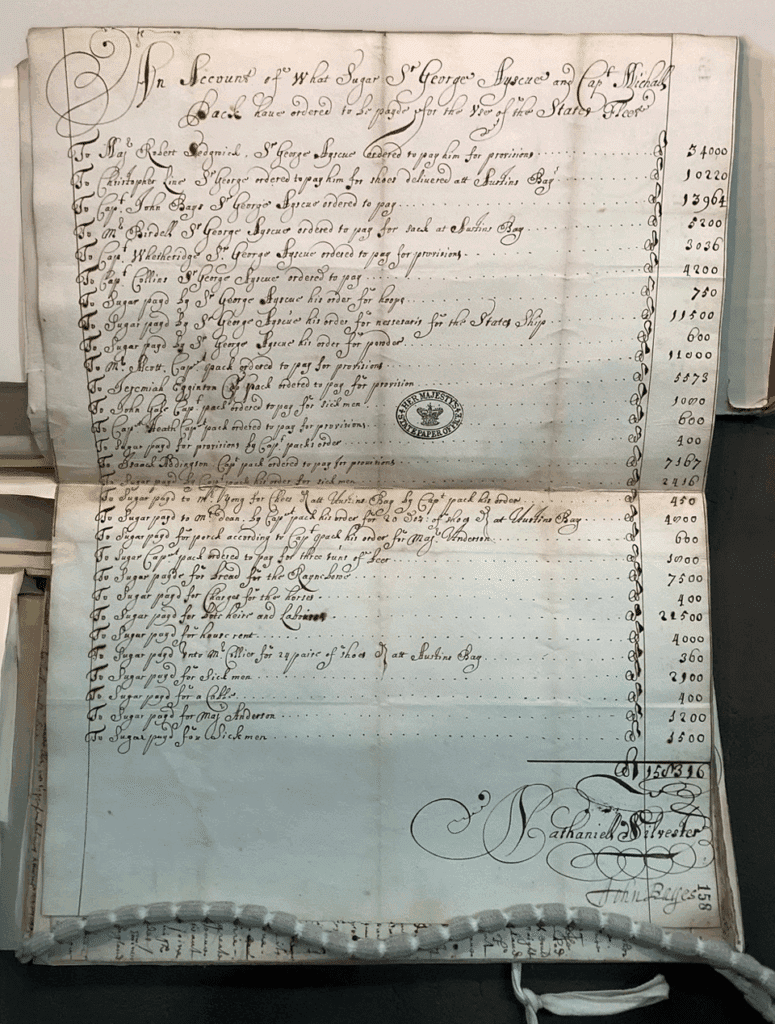
In the coming weeks, as we further research and analyze our findings, we will continue to share new information and narratives concerning the history of the Sylvester family, Shelter Island, and their place in this uniquely American story.